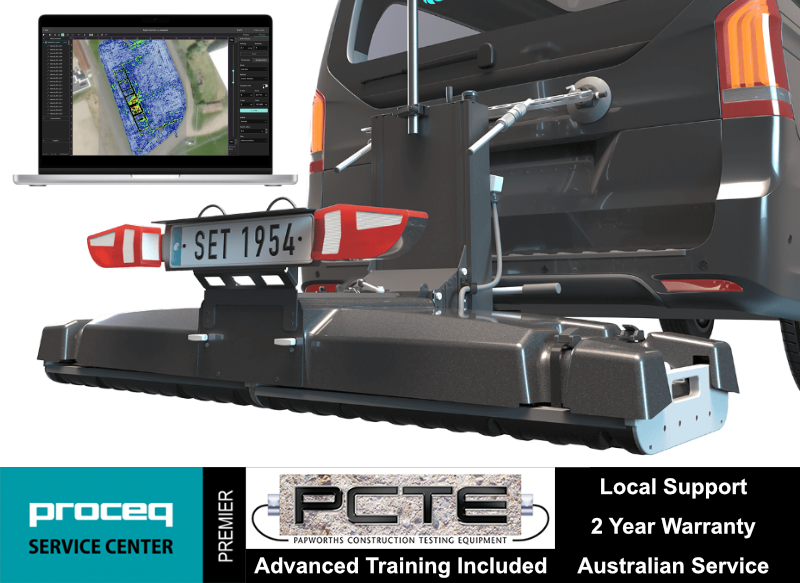
With years of experience and a strong track record in providing concrete GPR solutions, PCTE is the go-to supplier for reliable concrete scanning equipment. Our products offer precise, non-invasive scanning of concrete surfaces, helping you detect structural issues before they become a problem.
Concrete GPR: Why Choose It for Your Testing Needs?
Ground Penetrating Radar (GPR) is a non-invasive technique that provides real-time subsurface images of concrete structures. Concrete GPR is commonly used to detect embedded reinforcement, assess concrete thickness, and locate voids or cracks without damaging the surface. PCTE’s GPR concrete-scanning equipment is designed to make concrete inspections quicker, safer, and more efficient.
Using concrete-scanning equipment enables precise mapping of subsurface conditions, providing crucial information to engineers and contractors before drilling or cutting. Whether you're performing routine inspections or analysing complex structural conditions, PCTE’s concrete GPR systems ensure accurate results that help you make informed decisions.
Explore More of Our Range
Discover our high-performance products tailored to drive the success of your projects:
-
Construction Testing Instruments & Tools: A comprehensive selection of tools for testing construction materials, ensuring they meet strict safety and quality standards.
-
Software Solutions: Cutting-edge software that supports data analysis, result documentation, and efficient reporting, enhancing your testing workflow.
-
Non-Destructive Testing (NDT): Our GPR equipment enables detailed assessments of materials without causing damage, making it ideal for structural and underground testing.
-
CMT Laboratory Equipment: Whether testing soil or concrete, our equipment delivers consistent, accurate results across a range of materials.
Warranty & Returns
PCTE provides a warranty on all concrete scanning equipment, ensuring that you can rely on our GPR concrete scanning equipment for years to come. Returns are accepted within 7 days if the equipment is unused and in its original condition. For more information, please refer to our Warranty & Returns Policy or contact us via Contact Us for further assistance.
Shipping & Delivery
PCTE offers fast, reliable delivery of all GPR concrete-scanning equipment. While delivery times are estimates, we work diligently to ensure your concrete scanning equipment arrives promptly. For any questions regarding delivery or shipping, please refer to our Shipping & Delivery Policy or contact our team via the Contact Us page.
FAQs
What is concrete scanning equipment used for?
Concrete scanning equipment is used to evaluate the condition of concrete structures by detecting internal elements like reinforcement, voids, cracks, and other subsurface anomalies. GPR concrete-scanning equipment provides precise, real-time imaging without damaging the concrete.
How does a concrete GPR scanner work?
A concrete GPR scanner uses electromagnetic waves that penetrate the concrete surface and reflect when they encounter objects such as rebar, pipes, or voids. These reflections are captured and processed to create a visual representation of the subsurface, enabling professionals to identify hidden features without invasive methods.
What types of concrete scanning equipment does PCTE offer?
Concrete GPR: Ideal for concrete inspection, detection of reinforcement, and voids.
Subsurface GPR: Designed for mapping underground utilities and other subsurface structures.
GPR Arrays: Multi-sensor systems for fast and detailed scans of large areas.
Utility Location GPR: Specialised for detecting and mapping underground utilities like pipes and cables.
What are the benefits of using GPR concrete scanning equipment?
The main benefits of using GPR concrete scanning equipment include non-invasive testing, real-time data acquisition, high accuracy, and the ability to detect issues without damaging the concrete surface. It’s an essential tool for construction professionals to ensure the integrity and safety of concrete structures.
How accurate is concrete scanning equipment?
PCTE’s concrete scanning equipment is highly accurate, providing clear, detailed images of subsurface elements. Our GPR concrete systems are designed to meet industry standards, ensuring precise detection of rebar, cracks, voids, and other structural anomalies within concrete.
How often should concrete scanning equipment be calibrated?
For optimal performance, it’s recommended to calibrate your concrete scanning equipment annually or after extensive use. Calibration ensures the system delivers accurate, consistent results, helping you avoid errors in subsurface analysis.
Can concrete scanning equipment be used on all types of concrete?
Yes, GPR concrete scanning equipment can be used on most types of concrete, including reinforced concrete, precast concrete, and thin slabs. It is a versatile tool that helps detect embedded elements such as steel reinforcement, electrical conduits, and other objects hidden within concrete.
%20vector%20logo.svg)